12 May 2026
Reading a neighbourhood: Barcelona’s districts
Barcelona is not one city but ten districts, each with its own character. A short guide to how they differ - from the ordered grid of the Eixample to the village streets of Gràcia - for anyone deciding where to live.
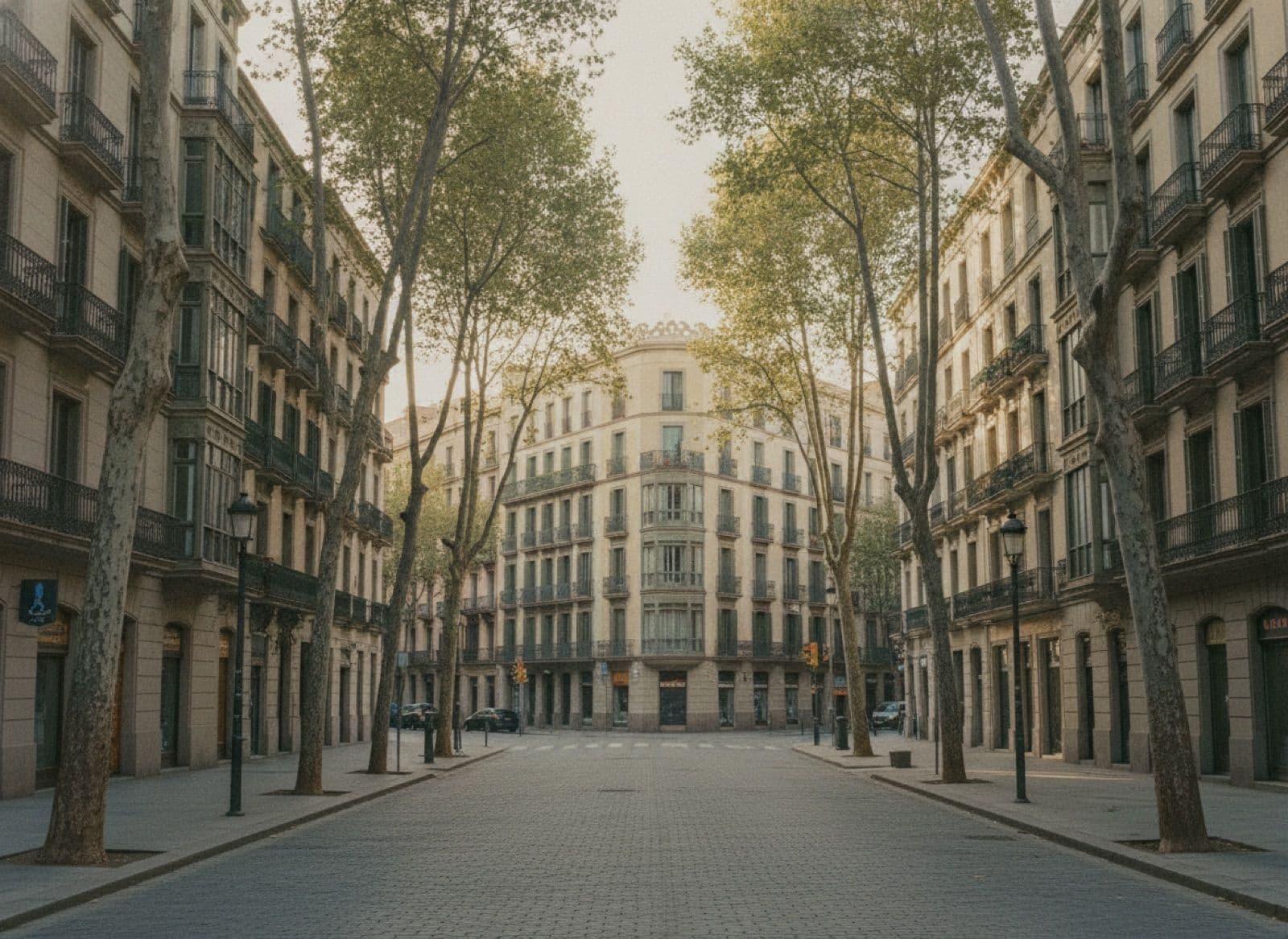
Barcelona is officially organised into ten districts and seventy-three neighbourhoods. To an arriving buyer that can read as an abstraction; in practice it is the most useful map there is. Each district has its own history, its own street pattern, and its own rhythm of daily life - and the differences between them matter more than any single apartment.
The Eixample: the ordered grid
The Eixample - literally the “expansion” - was laid out in the nineteenth century to the plan of the engineer Ildefons Cerdà, approved by royal decree in 1860. Its signature is a strict grid of square blocks with chamfered corners, cut back at an angle to open up light, air and sightlines. It remains one of the most legible pieces of urban design in Europe.
It is also where the city keeps much of its modernista architecture. Along Passeig de Gràcia stands the Illa de la Discòrdia, where three houses by three architects sit side by side - Gaudí’s Casa Batlló, Domènech i Montaner’s Casa Lleó Morera, and Puig i Cadafalch’s Casa Amatller. Gaudí’s Casa Milà and the Sagrada Família are here too. For a buyer, the Eixample offers wide, ordered streets, generous first-floor apartments, and interior courtyards you would never guess from the pavement.
Gràcia and Sarrià: the villages within the city
Both Gràcia and Sarrià were independent towns before Barcelona absorbed them - Gràcia in 1897, Sarrià as late as 1927 - and both still feel like it. Gràcia keeps a village character of narrow one-way streets gathered around small squares, in deliberate contrast to the grid it borders; it is the city’s smallest district by area, and every August its decorated streets fill for the Festa Major.
Sarrià-Sant Gervasi rises to the north-west, uphill toward the wooded Collserola hills. It is quieter and residential, and its old cores keep the same small-town streets - a greener, more private Barcelona, with the centre still a short ride away.
Ciutat Vella and the seafront
Ciutat Vella is the old city: the Gothic Quarter with the cathedral and Santa Maria del Mar, El Born, El Raval and La Barceloneta, all threaded by La Rambla down to the water. La Barceloneta itself is a planned eighteenth-century maritime quarter, first built out around 1754 on a tight grid of narrow blocks.
The seafront to the north-east is younger. Much of it was remade for the 1992 Olympic Games, when the Vila Olímpica was built, the waterfront was opened to the sea and the city beaches were created. Beyond it, the former industrial Poblenou - once nicknamed the “Catalan Manchester” - has been rezoned since 2000 as an innovation district. It is the part of the city that has changed most in a generation.
Reading between them
No district is simply better than another; they answer different questions. The grid or the village. The old stone or the open sea. The point of knowing them is to match a place to a life, not to a listing - which is the part we help with, quietly, before the search narrows to a single door.
If you would like to talk through where in the city might suit you, we would be glad to begin the conversation.